Computational Physicist & Simulation Architect
Happy surprises often arrive only after we have made peace with the possibility that they may never come. When one arrives through an encounter with someone who taught you, guided you, or helped shape part of your awareness—or through meeting a younger version of yourself carrying the same dreams and ambitions—it becomes more than a pleasant moment. Sometimes, that encounter is exactly what you need to remember why you started, and why you continued along the path you chose even when it felt lonely, despite the difficulties and shocks that tried to distract or obstruct you, and amid all our responsibilities toward the people who give our lives meaning.
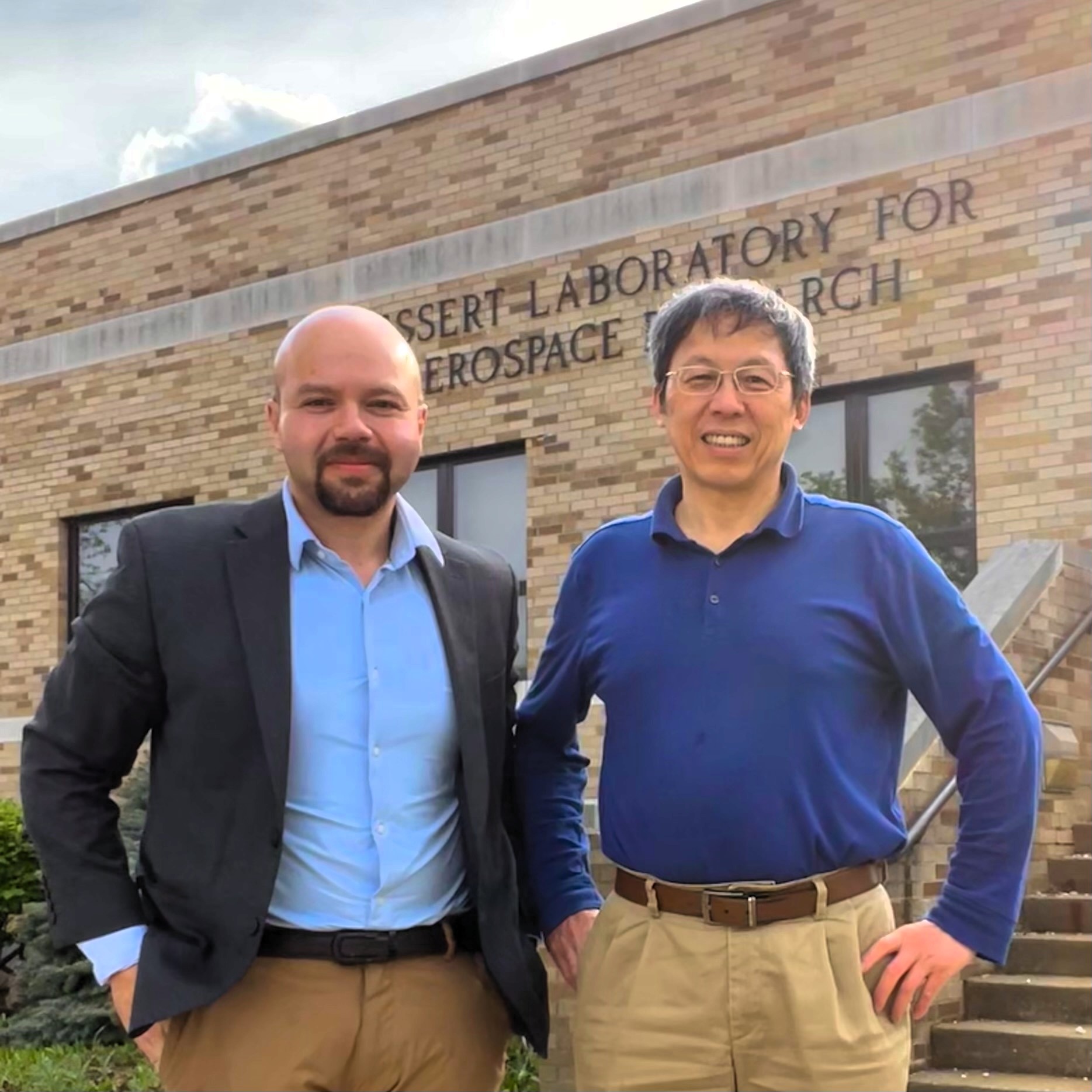
Such encounters are rare. The most recent came during my latest visit to the University of Notre Dame, where I was attending a meeting of the Industrial Advisory Council for the Department of Aerospace and Mechanical Engineering. As usual, I met several professors who had taught me during my Ph.D. Yet each time, I found myself looking for my advisor, Professor Meng Wang. I would visit his office in the morning or around noon and find that he was not there. This time, I remembered that he is, like me, a night owl. As a research group, we often began our work in the evening after classes—whether teaching or attending them—and continued as computationalists into the early hours of the next morning. A computationalist, in this context, is a researcher who uses mathematical models, algorithms, and computers to understand physical phenomena. By then, the laboratory would be quiet, after most of the experimentalists working in the wind tunnels had left.
I called him at six in the evening and found him in his office, effectively beginning his day after the Hessert Laboratory for Aerospace Research had settled down. We met and talked for several hours. Our conversation began with the day I joined his research group, then moved through my transition after defending my Ph.D. to computational modeling and simulation R&D at Ansys, and finally to my more recent move into energy, reservoir simulation, and oil recovery and production.
We spent considerable time on the question connecting these fields: How can the computational techniques and advanced mathematics used to simulate seconds or minutes of airflow and fluid motion around small- and medium-scale aircraft and rocket systems—domains measured in meters in the upper atmosphere—also be used to simulate hydrocarbon formation in sedimentary basins, migration through porous formations thousands of meters below the surface, across distances of thousands of kilometers, and over long geological timescales?
From there, we examined the similarities and differences in constructing the simulations themselves: from meshing, to domain decomposition and parallelization, and then to the governing flow equations. Simulations of airflow and free-fluid motion commonly begin with the classical Navier–Stokes equations, whereas flow through porous media is described using Darcy’s law for oil and gas reservoir simulation. The resulting linear systems, matrices, and solution methods also differ. The spatial and temporal scales separating the two problems are not secondary details; they influence how the entire model, algorithm, and computational solution must be constructed.
That was not the end of our conversation. He invited me to dinner with him and his wife the following evening, after I had completed the responsibilities of my visit. There, at an Italian restaurant, he began sharing life experiences that he had never discussed with me before. I had always known him as exceptionally rigorous in professional matters, and that rigor was one of the qualities I learned from him. For the first time, we talked about our academic family tree. Although he is my academic father, we had never found time during my graduate studies to discuss it. We had been occupied with analyzing results, writing proposals for access to supercomputing resources, preparing reports for sponsors, writing research papers, and getting ready for conferences.
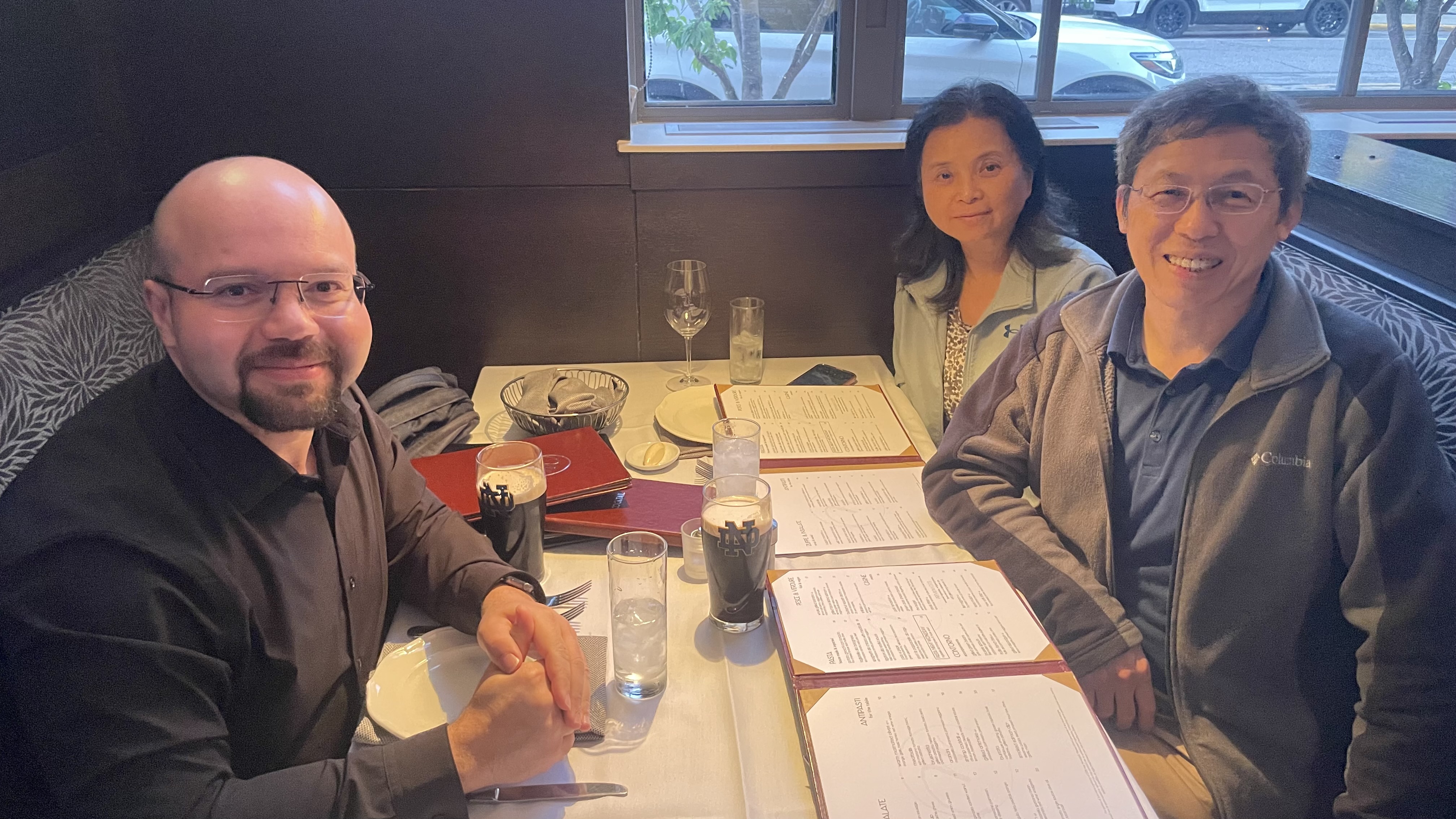
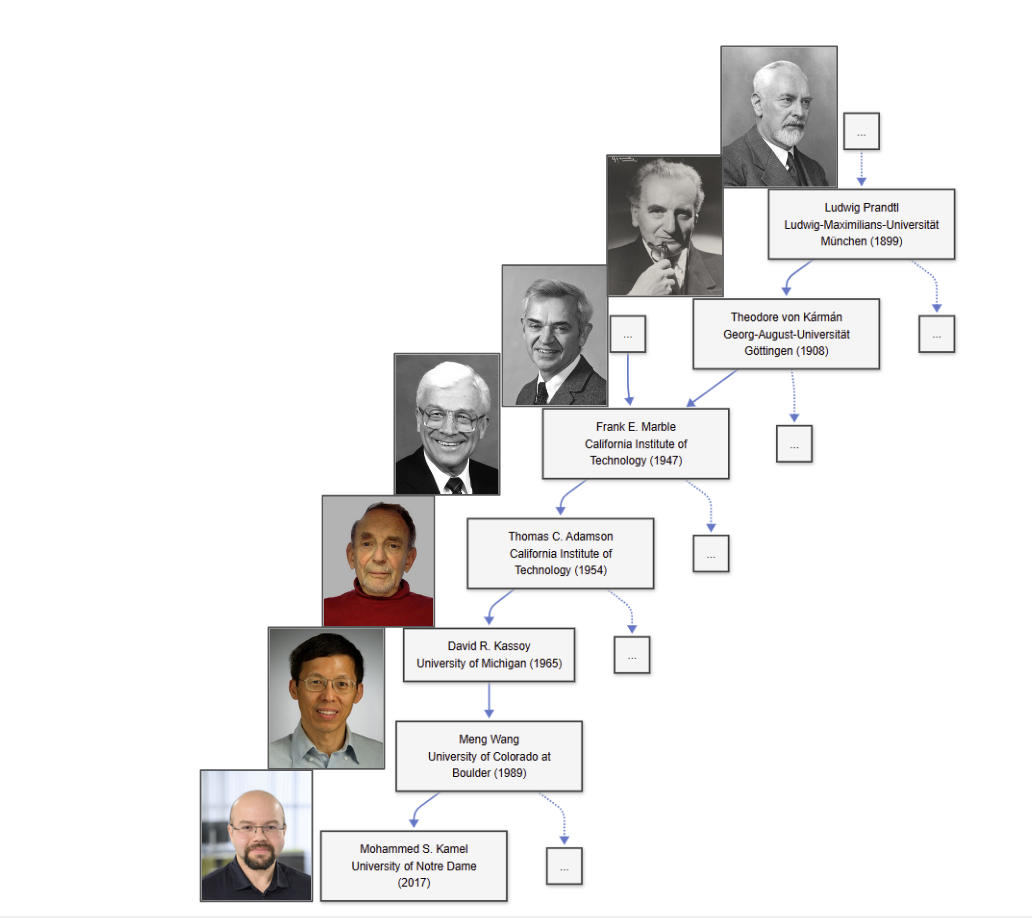
That evening, he showed me my academic family tree and the roots to which I belong. An “academic father” is not a family relation; it is the advisor under whom a researcher trains. Following that advisor’s advisor, and then the advisor before them, reveals an extended chain through which knowledge and research traditions pass directly from one generation to the next.
Through that continuous chain of direct mentorship, I found that my lineage extends from Professor Meng Wang through David R. Kassoy, Thomas C. Adamson, and Frank E. Marble, and eventually reaches two of the great pioneers of fluid mechanics and aeronautics: Theodor von Kármán and Ludwig Prandtl. The discovery brought a mixture of joy, pride, responsibility, and hope. Within the extended academic genealogy, I am one of 4,635 academic descendants of Prandtl and one of 1,743 academic descendants of von Kármán.
Prandtl was one of the founders of modern fluid mechanics, particularly through boundary-layer theory. The boundary layer is the thin region adjacent to a surface where the flow changes rapidly because of viscosity and friction. His theory made it possible to understand airflow around wings more precisely, including how it transitions from smooth laminar flow to irregular, vortical turbulent flow, and how microscopic surface roughness and other disturbances can contribute to that transition at different flight speeds. During World War II, results from his research were used to improve the aerodynamic design of German aircraft, although his own role was fundamentally scientific rather than one of direct military execution.
Across the Atlantic, Theodor von Kármán advanced our understanding of vortex dynamics and flow instability, and played a central role in connecting physics with engineering applications in aviation and rocketry. That connection helped prepare the ground for computational simulation of turbulent flow and for understanding the vortices formed in the wakes of moving vehicles, including how energy passes from large eddies to progressively smaller scales until it dissipates through what is known as the energy cascade.
Von Kármán was also among the early founders of the Jet Propulsion Laboratory (JPL). He supported rocket-propulsion research during World War II and helped establish a scientific foundation on which later space programs would build. My advisor and I spoke about two of von Kármán’s most distinguished collaborators in the laboratory’s early history: Frank Marble, my academic grandfather and a professor at the California Institute of Technology (Caltech), and his close friend Hsue-shen Tsien. McCarthyism separated them, and Tsien eventually returned to China, where he later played a foundational role in the country’s aerospace program. The two friends met again in China in the 1980s.
As the conversation continued, I became immersed in a sense of pride and happiness at the surprise and at this direct scholarly connection to those pioneers. During my studies, I had never been particularly interested in tracing or asking about that lineage. I had held closely to a verse attributed to Hassan ibn Thabit:
A young man is not one who says, “My father was.”
A young man is one who says, “Here I am.”
Academic lineage does not hand anyone an accomplishment. It does, however, remind us of the responsibility we inherit. That realization awakened in me a strong sense of responsibility toward what we should contribute to the scientific and engineering community, how we transfer our experience to colleagues from rising generations, and how we direct our future energy toward finding fundamental solutions to problems in turbulent fluid mechanics that the scientific community has long struggled to understand deeply—or has grown accustomed to treating without searching hard enough for alternative perspectives.
Since the 1970s, major investment and innovation have moved directly into computational methods for fluid mechanics in response to industrial and military competition. That movement helped produce an army of brilliant quantitative researchers, or quants, who transformed numerical methods and large-scale data processing. Their influence did not remain confined to fluid mechanics in aerospace, energy, weather prediction, galaxies, and stars. It extended to the simulation of chaotic systems such as stock markets, hedge funds, and FinTech, as well as to high-performance computing and artificial intelligence and machine learning (AI/ML). What connects these fields is the effort to convert a complex system into a quantitative model that can be tested, improved, and used to support decisions.
In line with that realistic and pragmatic direction—solving complex problems at genuine engineering and industrial scales—my goal after the Ph.D. was to enter industry directly rather than academia. I wanted to create a more immediate impact in fluid mechanics in particular and physical simulation more broadly, while establishing a direct path for myself in high-performance computing and aerospace through one of the world’s largest engineering simulation software companies, Ansys.
The decision was balanced economically, scientifically, and practically, despite the many obstacles industrial researchers face when publishing their work. These include intellectual-property restrictions, the difficulty of making the case for patenting digital inventions, and the decision to retain many innovations as trade secrets to avoid the high cost of patents—especially when the technology would be difficult for competitors to rediscover or reverse-engineer. An industrial researcher may therefore complete deep and consequential work that cannot appear fully in the published literature.
One example of a problem that remains open is turbulent flow over surfaces. Despite the apparent simplicity of its description, the organization of its vortices is remarkably complex. Some structures begin as microscopic eddies near the surface, then align and interact to form larger structures extending in the streamwise direction and eventually forming what are known as superstructures. This leads to an inverse sequence of vortex organization, from smaller structures toward larger ones. It does not mean that the energy cascade in free turbulence simply reverses; rather, the organization of coherent structures near a surface differs from the simplified picture of energy passing only from large eddies to smaller ones.
For this reason, turbulent flow over surfaces remains one of the most challenging cases for those who model it. In the absence of a closed mathematical model that describes every detail, many aspects are left to high-fidelity numerical simulation. Yet those simulations require rigorous setup to produce accurate results consistent with laboratory measurements—often more rigorous than many free-shear turbulent-flow cases.
My doctoral dissertation was among the early works to provide successful numerical-simulation configurations and computational turbulence models for high-speed, wall-bounded turbulent flow under realistic flight conditions. It also predicted how this flow affects electromagnetic fields, such as high-energy lasers propagating through it, with strong agreement against laboratory measurements. Even so, I still find myself trying to understand—or looking for someone who can convince me that they understand—the unifying nature or theory behind the different forms of turbulent flow.
I believe an opportunity still exists, particularly after the advances in computing capabilities, artificial intelligence, and deep neural learning. These tools may help us understand the physics governing the formation and disappearance of vortices across different types of turbulent flow. They may also help us study turbulence as an unstable flow whose behavior can, in part, be approached from an optimization perspective, especially in data-driven modeling. This perspective asks which state or representation best explains a system’s behavior under a defined set of constraints.
Using data, however, does not mean abandoning the computational basis grounded in differential equations. The real challenge is to build a bridge between them, whether the problem is a boundary-layer flow over a wing or vortex-shedding flows in the wakes of vehicles. Although I work in industry, I believe that somewhere along the extension of this academic tree, I will be able—in one way or another, and even in a small measure—to contribute to solving problems that affect hundreds of scientific and engineering applications.
I believe the next stage will not be merely another advance in computing. It may redefine how we understand physics itself. Perhaps my role is not simply to remain an extension of this academic tree, but to contribute—even in a small way—to adding a new branch: one that connects physics, computation, and artificial intelligence, and helps solve what has resisted understanding for decades.